Anyone who has taken up a hobby in the last few years knows the pattern. You decide to learn watercolor, linocut printing, crochet or beginner guitar, and within a week you have a pile of tutorial videos spread across YouTube, Facebook and Instagram. The best ones are the short, specific clips: how to mix a gray that is not muddy, how to hold a carving gouge, how to fix a dropped stitch. They are also the clips most likely to be edited, hidden or deleted next month.
This article asks a plain question for hobbyists and small craft teachers: what do you actually get for your money, time and attention when you save those clips? The tool in question is a free downloader that needs no account and no install, and everything below is based on what EzyDownload says on its public pages as read on 13 November 2026, plus the limits it states itself.
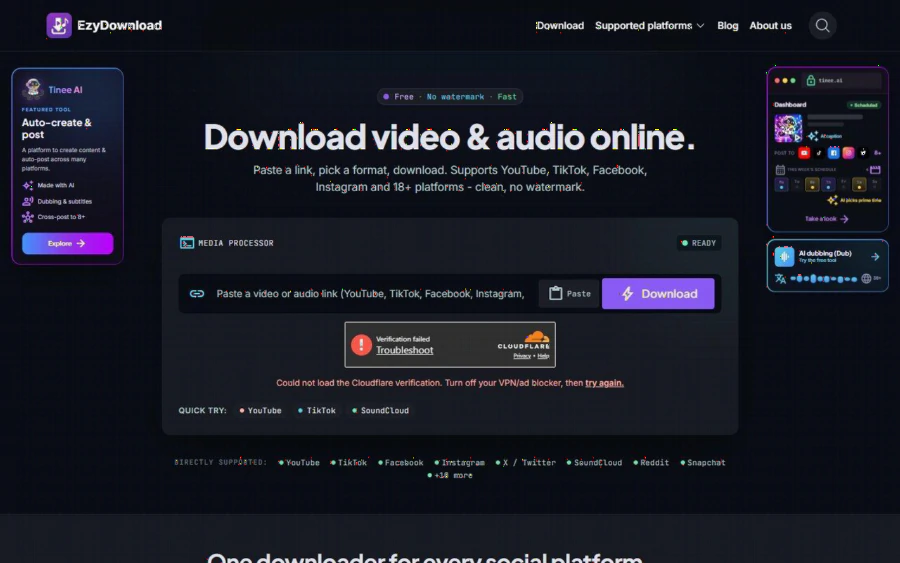
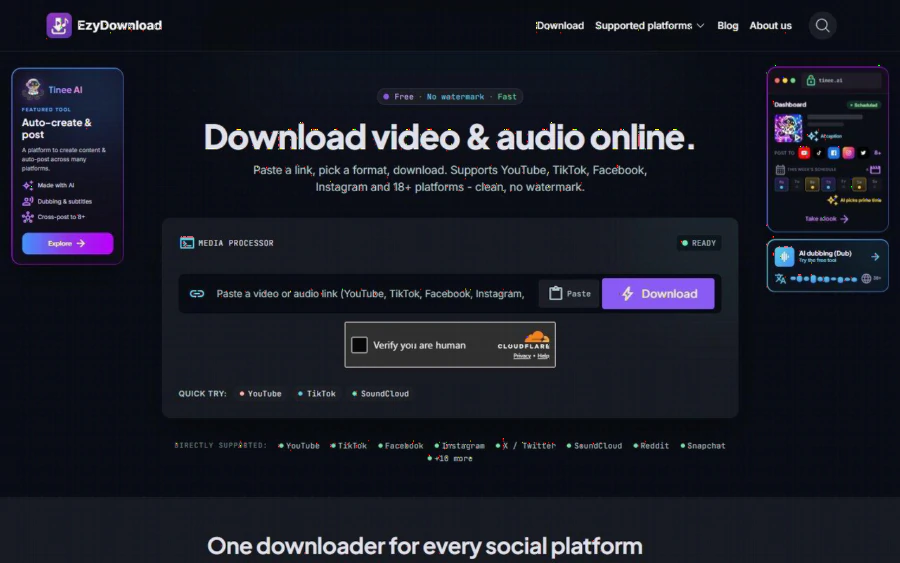
EzyDownload homepage with a link box, a Download button and a list of directly supported platforms
Counting the real cost of saving a tutorial
Value for a hobbyist is rarely about a subscription price. It is about three smaller costs that add up.
The first is money. EzyDownload's pages describe it as free, with no paid plan or subscription, and I found no stated cap on basic downloads. That is the vendor's claim, so check it yourself on your first few saves. A paid desktop downloader or a yearly "pro" tier would cost you something every year for what is, for most hobbyists, a handful of clips a month.
The second is time. A tool that asks you to click through several pop-ups, hunt for the real button and dismiss an install prompt turns a ten-second job into a two-minute one. Do that for twenty clips and you have lost most of an evening that could have gone to the actual craft. EzyDownload's About page describes its flow as "paste a link, pick a format, and download. Nothing more." That is the right shape for the job.
The third is risk. Many free savers come bundled with ads or prompts to install extra software. The same About page says EzyDownload does not store files or keep history. I cannot audit that from the outside, so treat it as a stated policy rather than proof, and keep your usual antivirus and browser protection on.
What it does that a hobbyist can use
The homepage says it supports YouTube, TikTok, Facebook, Instagram and more than 18 platforms in total. For a craft learner the useful pieces are these.
Video quality is a real choice. The YouTube page says you can grab MP4 up to 4K at 60fps when the source offers it, with lower options starting at 360p. For crafts this matters. A close-up of brush pressure or thread tension is hard to learn from when it is blurry, while a 360p copy is plenty for a talking-head explanation you only need to hear.
Audio-only is available too. The same page mentions MP3 and M4A extraction, with ID3 tags such as title, artist and cover art. If you learn music, that means a practice track or a teacher's backing loop can sit on your phone and play offline during a commute.
Short-form clips are covered. The site lists Reels, Shorts and Stories among supported content types, and it says it removes the watermark by downloading the original stream. Many craft tips live exactly there, in thirty-second vertical clips.
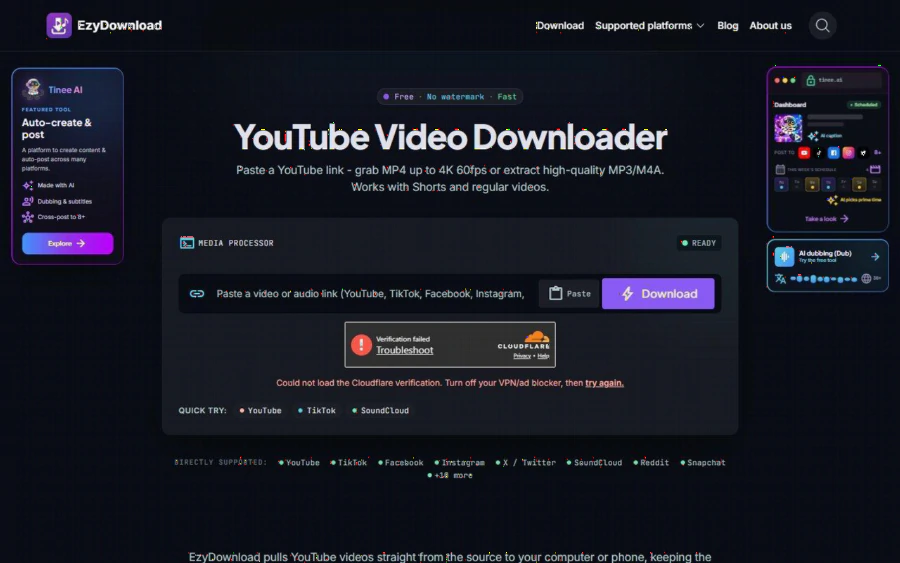
EzyDownload YouTube page describing MP4 up to 4K 60fps and MP3 or M4A audio
A minimal return-on-effort example
Here is an illustration, not a real customer story. Imagine a beginner ceramics student who wants to keep twelve public clips on wheel centering and trimming before a six-week evening class. Her routine is to paste each link, choose 1080p for the hands-on demos and MP3 for two spoken explanations, and put the files in one folder named by week.
The effort is about half an hour once. The return is a small offline library she can open in the studio, where mobile signal is poor, and rewatch the exact ten seconds she needs without scrubbing through an app feed. If any clip is later taken down by its creator, her copy for personal study is still there. That last point is where the value is easiest to see, and also where responsibility starts.
Limits you should know before you rely on it
Good advice includes the awkward parts, so here they are, all taken from EzyDownload's own pages.
Only public media works. Private accounts, paywalled lessons and login-protected courses will fail, and DRM content is not processed. If your teacher sells a course, buy it and use the official download or viewing option.
At the highest resolutions some platforms split video and audio. If only separate streams exist, you may need to merge them with an external tool such as HandBrake or FFmpeg. That is a small extra step beginners may find annoying.
The site uses a Cloudflare verification step. When I opened the pages for the screenshots, the check could not load, and the page told me to turn off a VPN or ad blocker and try again. If you see the same message, follow that advice before assuming the tool is broken. It is a nuisance, but it is also the kind of protection that keeps bots away.
The homepage also shows promotions for a separate AI content platform and a sponsor link. They are not part of the downloader, and you can ignore them, but you should know they are there.
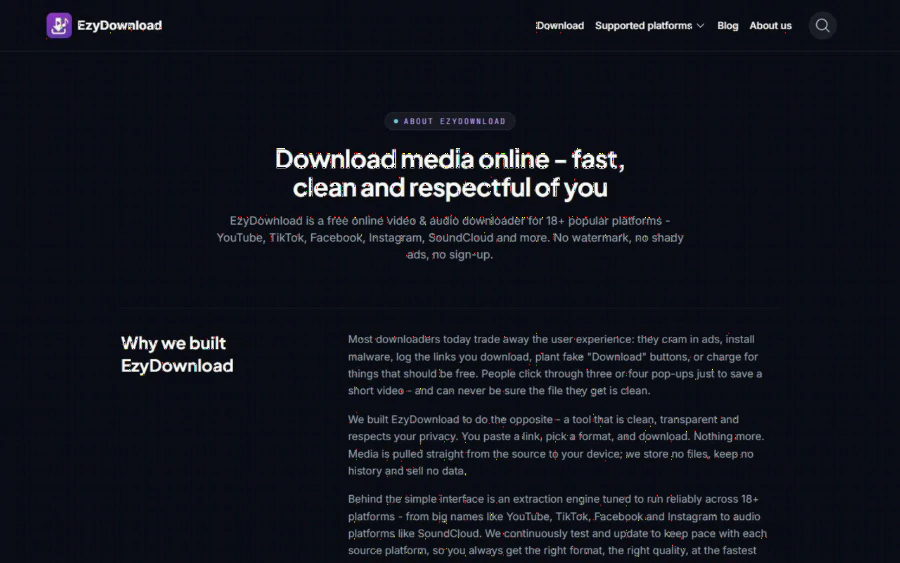
EzyDownload About page explaining the free, no sign-up approach
Who should use it and who should not
It suits hobbyists who save a modest number of public tutorials, hobby teachers who want a reference folder for their own lessons, and anyone who learns in places with weak internet.
It is a poor fit if you need bulk archiving of entire channels, if the lessons you want sit behind a login, or if you plan to republish other people's work. Respect the rights of the creators. Save for personal study, credit teachers when you share what you learned, and never pass someone else's clip off as your own.
How to start in five minutes
Open the homepage, copy the address of a public tutorial from your browser, paste it into the link box and pick a format. Test with one clip first: check the file plays, the sound is in sync and the resolution is enough for the detail you need. Name the file after the technique, for example "linocut-gouge-grip", so you can find it months later.
If the first save goes well, repeat it for a short list of your best lessons, and keep a simple note of where each came from. The EzyDownload blog also carries step-by-step guides if you get stuck. In short, the value is small but real: a few minutes of setup, no recurring fee, and a personal library of public lessons that stays yours for study. Judge it on your own first five clips, not on any promise made here.